Central Branch Avenue Sector Plan Minor Amendment and SMA
Central Branch Avenue Sector Plan Minor Amendment and SMA
Michael Calomese
- Community Planning Division
- Master Plans and Studies
TEL: 301-952-3179
EMAIL: michael.calomese@ppd.mncppc.org
Korey Arsenault
- Community Planning Division
- Master Plans and Studies
TEL: 301-952-4317
EMAIL: korey.arsenault@ppd.mncppc.org
Kierre McCune
- Community Planning Division
- Master Plans and Studies
TEL: 301-952-3211
EMAIL: kierre.mccune@ppd.mncppc.org
District Council Work Session – September 29, 2026
The County Council, sitting as the District Council, will hold a Work Session on Tuesday, September 29, 2026, to review testimony and the Planning Board Resolutions of Adoption and Endorsement. Any interested parties can attend the meeting in person at the Wayne K. Curry Administration Building (1301 McCormick Drive, Largo, MD 20782) or watch live on the County Council webpage. District Council action is anticipated to occur before the end of October.
Planning Board Adopts the Minor Plan Amendment and Endorses the Sectional Map Amendment – September 17, 2026
On Thursday, September 17, 2026, the Prince George’s County Planning Board voted to adopt the Minor Plan Amendment, with amendments, to the Central Branch Avenue Corridor Revitalization Sector Plan, and endorse the concurrent Sectional Map Amendment (SMA), with amendments, via PGCPB No. 2026-060 and PGCPB No. 2026-061.
Through these resolutions, the newly adopted Minor Plan Amendment and SMA reflect the changes discussed during the Work Session with the Planning Board, also held during their meeting on September 17, 2026. A recording of the meeting can be viewed on the Planning Board webpage here.
The adopted changes respond to testimony heard at the Joint Public Hearing held on Monday, June 29, 2026, and submitted in writing before the close of record on Tuesday, July 14, 2026.
Joint Public Hearing and Close of Record
The Prince George’s County Planning Board and the County Council held a Joint Public Hearing on Monday, June 29, at 6:00 p.m. The hearing took place at the Wayne K. Curry Administration Building (1301 McCormick Drive, Largo, MD) to receive public verbal testimony on the Proposed Minor Plan Amendment and Sectional Map Amendment to the Central Branch Avenue Corridor Revitalization Sector Plan. Written testimony was accepted until the close of business on Tuesday, July 14, 2026. A video of the Joint Public Hearing is available to view through the County Council’s website.
Release of the Proposed Sectional Map Amendment
The Prince George’s County Council, sitting as the District Council, initiated a minor amendment and a concurrent Sectional Map Amendment (SMA) to the 2013 Approved Central Branch Corridor Revitalization Sector Plan and a concurrent Sectional Map Amendment (SMA) through Council Resolution CR-035-2026.
The SMA is a process that facilitates the rezoning of properties within a plan’s boundary. Typically, this process results in zoning changes for only a few properties, and the remaining properties keep their existing zoning classification. All proposed zoning changes are noted in this document for further review: Central Branch Avenue Corridor Revitalization Sector Plan Proposed Sectional Map Amendment.
A physical copy is available for review on site at no cost at the following locations:
- Morningside Town Hall, 6901 Ames Street, Morningside, MD 20746
- Surratt House Museum and Research Center, 9118 Brandywine Road, Clinton, MD 20735
- M-NCPPC, Department of Parks and Recreation, Prince George’s County, 6600 Kenilworth Ave, Riverdale, MD 20737. In addition, owners of property that is subject to any proposed zoning change will receive a letter in the mail detailing the recommended changes.
Also, as a matter of transparency, a methodology of how zoning changes were proposed for the SMA has been provided.
All interested persons will have the opportunity to provide testimony regarding the Proposed Zoning Changes and the Preliminary Amendments to the 2013 Approved Central Branch Corridor Revitalization Sector Plan. See the Joint Public Hearing section below for more information.
Scheduled Joint Public Hearing – June 29, 2026
The Prince George’s County Planning Board and the County Council will hold a Joint Public Hearing on Monday, June 29, 2026, at 6:00 p.m. The hearing will take place at the Wayne K. Curry Administration Building (1301 McCormick Drive, Largo, MD) to receive public testimony on the Central Branch Avenue Corridor Revitalization Sector Plan Minor Plan Amendment and Sectional Map Amendment (SMA).
Register to Speak or Submit Testimony
- Use the Council’s eComment portal: https://pgccouncil.us/Speak.
- Email written comments to onlinesignup@co.pg.md.us.
- Onsite registration will be available, but advance registration is strongly encouraged.
- Speakers will have 2 minutes for oral testimony.
- Written comments will be accepted until the close of business on Tuesday, July 14, 2026.
Affidavit Requirement for Zoning Intensification
The Proposed SMA includes potential zoning intensification within the SMA boundaries.
If you plan to request or support zoning intensification in your oral or written testimony, you must file an affidavit under the State Public Ethics Law (General Provisions Article §§5833–5839).
Deadline: Affidavits must be submitted via the eComment portal or emailed to onlinesignup@co.pg.md.us no later than Friday, May 29, 2026.
Failure to file by the deadline may delay or prevent the District Council from considering your testimony.
Ex Parte Communication Disclosure
Under Section 2296 of the Prince George’s County Code and General Provisions Article §5836:
- Any communication with a County Council Member or the County Executive regarding the plan or SMA must be disclosed.
- An ex parte disclosure form must be filed within five (5) working days of the communication.
Affidavit Forms (Maryland State Ethics Commission)
- Individuals: https://ethics.maryland.gov/wp-content/uploads/filebase/local-gov/local-gov-forms/PGNO1.pdf
- Entities: https://ethics.maryland.gov/wp-content/uploads/filebase/local-gov/local-gov-forms/PGNO2.pdf
- Agents: https://ethics.maryland.gov/wp-content/uploads/filebase/local-gov/local-gov-forms/PGNO3.pdf
Special Ethics Law Memo
For questions about affidavits or ex parte disclosures, contact the Maryland State Ethics Commission at (410) 260-7770.
Initiation of the Minor Amendment to the Central Branch Avenue Corridor Revitalization Sector Plan and Sectional Map Amendment (SMA) – May 5, 2026
On Tuesday, May 5, 2026, the Prince George’s County Council, sitting as the District Council, initiated a minor amendment to the 2013 Approved Central Branch Corridor Revitalization Sector Plan and a concurrent Sectional Map Amendment (SMA) through Council Resolution CR-035-2026.
The Minor Plan Amendment is necessary to incorporate the recommendations of the 2026 Medical Innovation District Feasibility Study that are relevant to the Sector Plan, and to remove specific policies and strategies from the 2013 Approved Central Branch Avenue Corridor Revitalization Sector Plan that were inserted into the 2014 Approved Southern Green Line Station Area Sector Plan upon the passage of Council Resolution CR-103-2023 by the Prince George’s County Council, sitting as the District Council.
The SMA is a process that facilitates the rezoning of properties within a plan’s boundary. Typically, this process results in a zoning change for only a few properties, and the remaining properties keep their existing zoning classification. The 2013 Approved Central Branch Avenue Corridor Revitalization Sector Plan was adopted without a concurrent SMA; this process initiated on May 5, 2026, is necessary to fully implement the vision laid out in the Sector Plan as adopted in 2013.
The Prince George’s County Planning Department is preparing an amendment to the 2013 Approved Central Branch Avenue Corridor Revitalization Sector Plan.
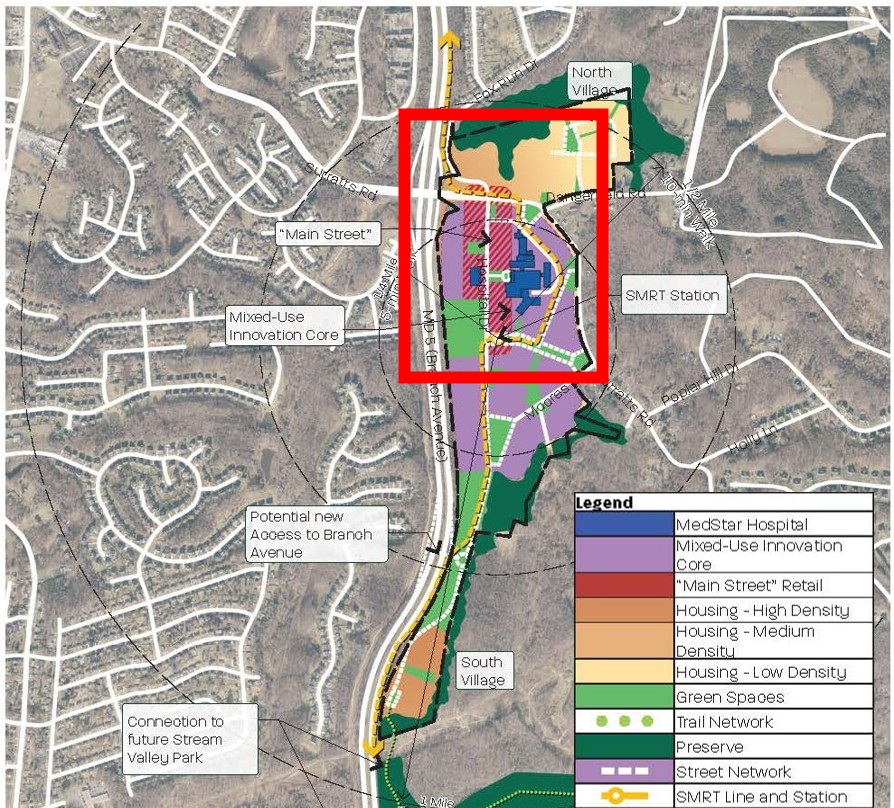
Guided by the 2014 Plan Prince George’s 2035 General Plan (Plan 2035), the plan update will combine public participation, real estate market analysis, land use and zoning review, and regional best practices to shape updated planning recommendations for the Southern Maryland Hospital Center Focus Area.
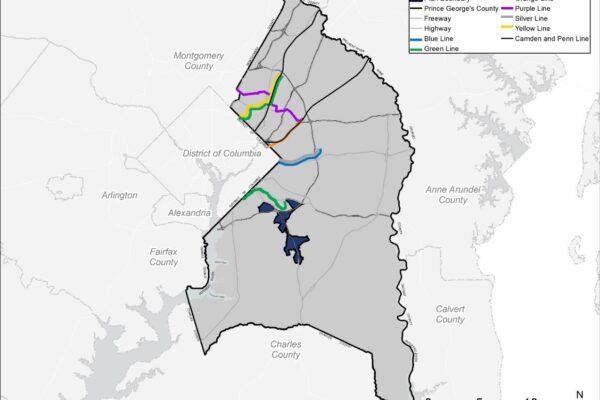
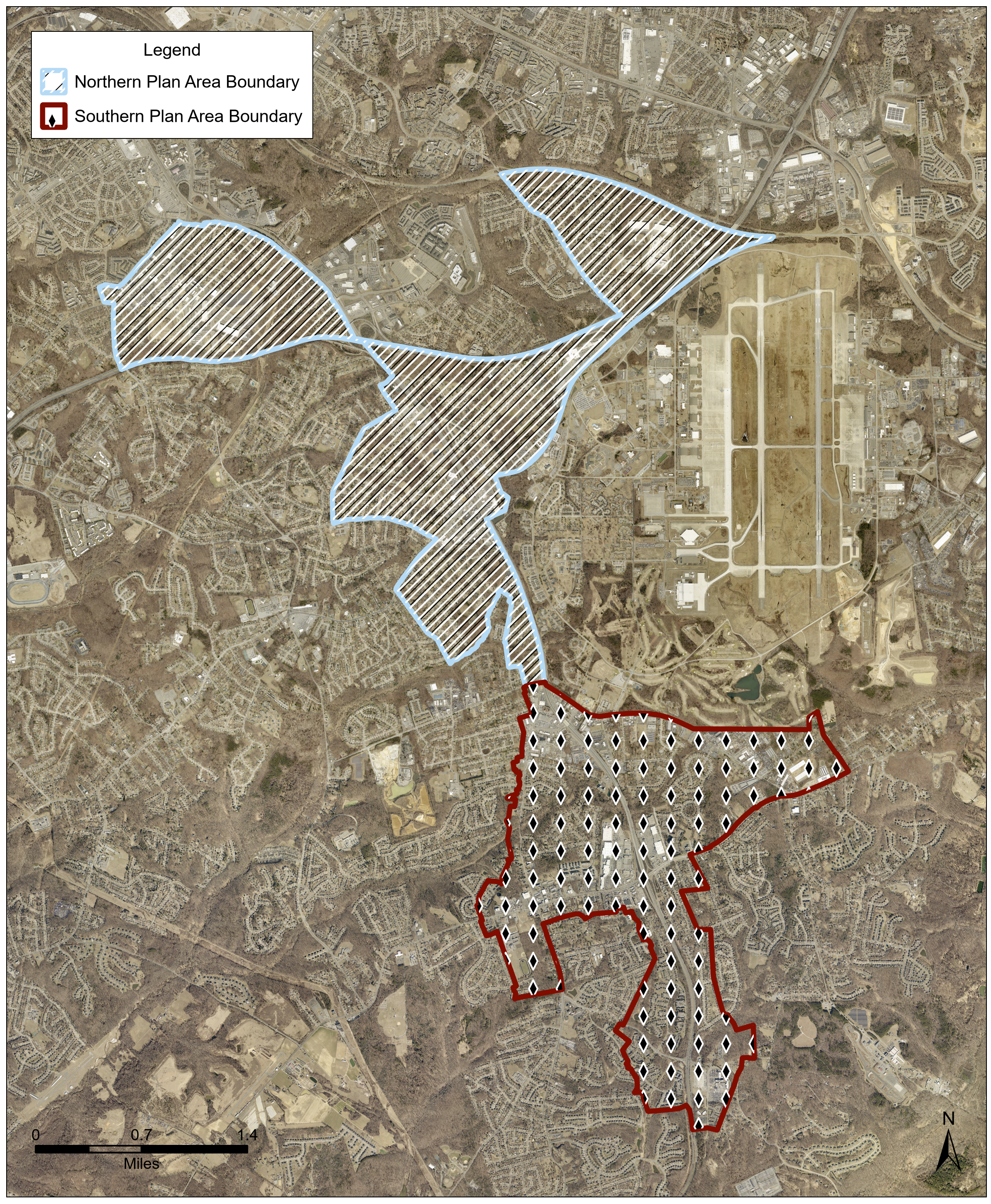
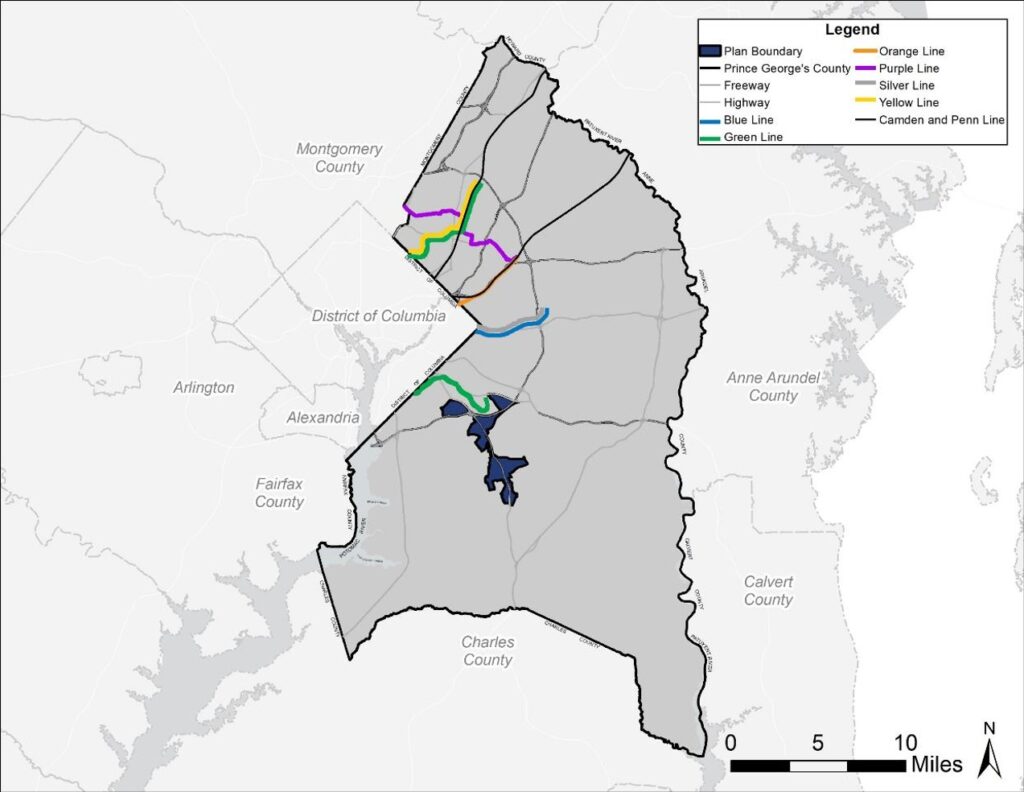
Covering approximately 8.84 square miles, the Central Branch Avenue plan area is a linear corridor that straddles the Capital Beltway (I-95/I-495), with a couple of areas inside the Beltway, and the majority of the corridor outside the Beltway along MD 5 (Branch Avenue).
The approved 2013 Central Branch Avenue Sector Plan was developed to build on the opportunities for growth and revitalization created by the potential future growth at Joint Base Andrews, the planned expansion of Southern Maryland Hospital, and the planned Southern Maryland Rapid Transit line along Branch Avenue. The goal of the minor plan amendment is to include recommended policies and strategies from the 2026 Medical Innovation District Feasibility Study, thereby adding greater robustness to existing policies and strategies in the sector plan’s Southern Maryland Hospital Center Focus Area. More on the 2026 Medical Innovation District Feasibility Study can be found here.
The planning process for the Central Branch Avenue sector plan included public engagement and plan development that took place between 2010 and 2012. This minor plan amendment will also be accompanied by an amendment to the zoning map, or a sectional map amendment. The sector plan was approved in 2013 without a sectional map amendment. The Central Branch Avenue sector plan has been long overdue for a sectional map amendment that fully implements the sector plan’s recommendations. Adoption of the sectional map amendment will fix this longstanding issue.
Minor Plan Amendment Focus Area
Sectional Map Amendment
Area Context Map
Timeline
| Milestone | Expected Timelines |
|---|---|
| Initiation | May 5, 2026 |
| Joint Public Hearing | June 29, 2026 |
| Planning Board Work Session and Action | September 17, 2026 |
| District Council Work Session | September 29, 2026 |
| District Council Action | October 13, 2026 |
FAQs
What is a Minor Plan Amendment?
A minor plan amendment is an update to an existing approved master plan or sector plan. Minor plan amendments are initiated by the County Council through a formal resolution. A plan amendment is classified as “minor” if it affects less than 50% of the area of the existing approved plan.
What is a Sectional Map Amendment?
A sectional map amendment (SMA) is a comprehensive rezoning amendment for properties within an entire geographic area, such as a subregion, planning area, or part of a planning area. The purpose of an SMA is to revise the zoning of property to conform to the recommendations of the applicable master plan or sector plan. An SMA is being done concurrently with this plan amendment and will recommend zoning changes for specific properties to achieve the sector plan’s vision and goals.
What is Zoning?
Zoning is the law that determines what can be built, where it can be built, and how it is built. Zoning works in two parts. The zoning ordinance is the written law and the zoning map shows where the different zoning regulations are applicable. There are several different types of zones including Residential, Industrial, Commercial, and Open Space zones. Associated with these zones are a list of land uses that are allowed and not allowed inside of them, for example, heavy industrial uses are not typically allowed in residential zones, but different types of homes are likely allowed. Different zones also have different permitted heights, densities, setback requirements, etc., all of which change the way the streetscape looks and feels.
What are the implications of any zoning changes on a property in the Central Branch Avenue sector plan area?
If the planning process recommends rezoning, that will happen at the end of the planning process through a legal update to the County Zoning Map. Even if a property is rezoned, nothing can physically happen to the property unless the owner initiates a change (e.g., sale or redevelopment). Keep in mind that general plans and master/sector plans only produce recommendations for the future; no change can occur to a privately owned property unless initiated by the owner.
How will I know if my property is recommended for a different zone?
If your property is recommended for rezoning through this sectional map amendment, you will be notified through U.S. Mail, per Section 27-3407. Scheduling of Hearings and Public Notice, of the County Zoning Ordinance. Plan and zoning recommendations are evaluated through:
- A public comment period through the Joint Public Hearing (Planning Board and District Council) process
- Work sessions
Should the County Council recommend additional amendments to the sector plan and/or sectional map amendment that were not raised in testimony at the Joint Public Hearing, they must hold an additional Joint Public Hearing on those amendments.
The Prince George’s County Planning Department welcomes and encourages public participation and feedback throughout the plan development and public review period. Note that it is the County Council that has the power to approve the plan and authorize changes to the zoning map.
Does a change in zoning mean I am at risk of losing my property?
No. A master/sector plan is aspirational; it outlines goals and makes recommendations for the future of a planning area over a 25-year period. Master/sector plans and zoning regulations do not remove ownership or impose development mandates on property owners. If a property owner wants to redevelop a property after the County approves a zoning change through the sectional map amendment, the requirements of the property’s new zoning classification would apply.
PROJECT MANAGER
DEPUTY PROJECT MANAGER
PROJECT FACILITATOR
Planning Supervisor, Master Plans and Studies Section
PHONE: 301-952-3211
EMAIL: kierre.mccune@ppd.mncppc.org


